
What is Common Technical Document Module 2.7?
The Common Technical Document (CTD) is a standardised format for preparing application dossiers for the registration of pharmaceuticals/medicinal products in participating regions [1]. The CTD comprises five modules that provide a standardised structure for presenting the quality, nonclinical and clinical information supporting a marketing application (see here for an overview of the entire CTD).
Here, we will focus on Module 2.7, the Clinical Summary [1].

Figure 1.Common Technical Document triangle
CTD = Common Technical Document.
The CTD is organised into five modules. Module 1 is region-specific and Modules 2‑5 are intended to be common for all regions [1].
Module 2.7, the Clinical Summary, is an important part of a drug application to regulatory authorities in participating regions. Module 2.7 provides reviewers with a detailed factual summary of the clinical information included in the submission, from clinical study reports (CSRs), meta‑analyses, cross‑study analyses, and in some cases post-marketing data.
What are the main requirements for Module 2.7 and how can Alchemy help?
At Alchemy, we have extensive experience in authoring clinical CTD modules. The key requirements for developing a comprehensive and effective Clinical Summary include:
1. Adherence to regulatory guidelines [1,2]
We ensure your Clinical Summary adheres to regulatory guidelines outlined by the International Council for Harmonisation of Technical Requirements for Pharmaceuticals for Human Use (ICH) and apply industry best practices to ensure consistency and compliance. The relevant general ICH guidelines for the Clinical Summary include the following:
- ICH M4(R4): Organisation of the Common Technical Document
- ICH M4 Q&As (R3): Common Technical Document Questions and Answers
- ICH M4E(R2): The Common Technical Document for the Registration of Pharmaceuticals for Human Use: Efficacy
- ICH M4E Q&As (R4): Common Technical Document for the Registration of Pharmaceuticals for Human Use: Efficacy – Questions and Answers
2. Module 2.7 content coordination
Our writers use their regulatory experience to guide your Clinical Summary through drafting and review cycles to incorporate recommendations from the sponsor, study team, subject matter experts, key opinion leaders, and internal governance.
3. Document publishing
We can perform submission-ready publishing of individual documents ahead of electronic CTD collation and publishing, which would be performed by a submission publisher.
4. Streamlining of entire CTD document
We offer streamlined writing support across all CTD modules to apply consistency, style preferences, and regulatory adherence across the CTD.
How Module 2.7 is used and its role within the regulatory framework
The primary role of the CTD is to provide a standardised format for preparing marketing authorisation applications, new drug applications, and biologic license applications in participating countries [3-5]. The CTD is mandated or strongly recommended in several regions and countries including Europe, the US, Japan, Canada, China, and Switzerland [1,6,7]. Implementation and submission requirements vary by jurisdiction and submission type.
By employing and adhering to the CTD document structure, the applicant ensures that all information is presented in the required format, thus facilitating the regulatory review process across different regions.
Module 2.7 focuses on summarising and integrating the clinical information available for an IMP. It is a document of approximately 50 to 400 pages excluding attached tables which, alongside the Clinical Overview (Module 2.5), provides the supporting information for the Summary of Product Characteristics or product label. Consistency across these documents is therefore crucial for ease of review [6]. The Clinical Summary is structured into four main sections, supplemented by literature references and synopses of individual studies:
- Module 2.7.1Summary of Biopharmaceutic Studies and Associated Analytical Methods
- Module 2.7.2Summary of Clinical Pharmacology Studies
- Module 2.7.3Summary of Clinical Efficacy
- Module 2.7.4Summary of Clinical Safety
Also included in Module 2.7 are:
- Module 2.7.5Literature References
- Module 2.7.6Synopses of Individual Studies
Together, these sections provide the reviewer with a comprehensive factual summary, integration and comparison of the clinical data from all clinical studies associated with the IMP [8]. Preparation of an informative Clinical Summary consistent with the rest of the CTD is essential to support applications for marketing authorisation of an IMP in participating regions [6].
What source materials are needed to write Module 2.7?
To develop a comprehensive and high-quality Clinical Summary, you will need to provide us with a range of documents including, but not limited to:
- Clinical Study Protocols
- CSRs
- Regulatory briefing documents (as appropriate for the submission)
- Investigator’s Brochure (IB)
- Statistical Analysis Plan, if available
- Integrated summaries/analyses and key data outputs (for Module 2.7.3 and 2.7.4, if applicable)
- Investigational Medicinal Product Dossier
- Post-marketing data, if available/applicable
- Target Product Profile (proposed product label)
- Regulatory briefing documents and responses/advice from regulatory agencies (as appropriate for the submission)
- Any relevant literature
- Sponsor style guide
- Other materials for appendices
What is the general timeframe for writing Module 2.7?
The timeframe for preparation of the Clinical Summary is typically a few months [9,10]. Timelines vary depending on the complexity of the submission, for example the number of indications being investigated and the volume of clinical data available [8]. Effective team alignment and communication from project kick-off will accelerate Clinical Summary development.
Overview of the development of CTD Module 2.7, the Clinical Summary [10]
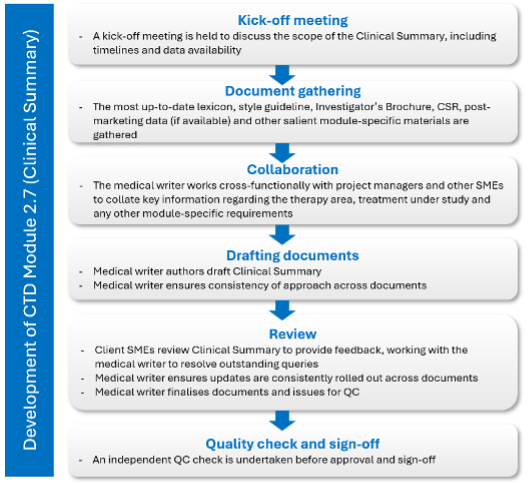
CSR = clinical study report; CTD = Common Technical Document; QC = quality control; SME = subject matter expert.
Alchemy’s top tips for authoring CTD Module 2.7?
The Clinical Summary should not simply reproduce or shorten the individual CSRs. Its purpose is to bring the clinical evidence together across studies, allowing the reviewer to identify patterns, compare results and understand the overall clinical dataset while maintaining a factual and objective presentation. The critical interpretation of the evidence belongs primarily in Module 2.5.
Crafting a high-quality Clinical Summary is critical for regulatory success. It gives you a chance to present the reviewer with a factual summary, analysis and comparison of all the clinical data available for your IMP. Here are Alchemy’s top tips for tackling Module 2.7:
1. Map it out
The Clinical Summary should summarise and integrate of all available clinical data, including meta-analyses and post-marketing data where available. Before you begin, it is crucial to:
- Plan ahead – make sure you have all source documents available to allow you to maintain momentum once you start writing.
- Map out an overview of the document, including the key messages that are to be highlighted for the reviewer. You can do this in a way that works best for you, be it Excel, PowerPoint, or good old‑fashioned pen and paper!
- Establish the prominence and emphasis of key messages.
- As you write, note gaps/insufficiencies in the data presentations, and be prepared to address those up front. Your main aim is to save the reviewer time and effort by proactively answering questions they may have, as well as keeping the key messages at the forefront.
- Carefully plan your appendices.
2. Stay connected, work efficiently
Often, multiple authors will be working simultaneously on the various components of Module 2.7, as well as other CTD modules. The contents of these documents often intertwine and overlap, so keeping in touch regularly and having an overarching plan in place to ensure consistency and reduce repetition will maximise efficiency.
3. Be factual and concise
The Clinical Summary is your opportunity to integrate all available data in a factual, structured and informative way. Information should be presented in a clear, succinct manner allowing the reviewer to quickly identify, understand and focus on key aspects of the submission. The effective use of tables or figures to convey important information should be employed where appropriate.
4. Ensure consistency and reduce redundancy across CTD modules
Reviewers will cross-check statements between Module 2.5 (Clinical Overview), Module 2.7 (Clinical Summary), and Module 5 (CSRs). It is therefore important to coordinate the CTD documents appropriately. Cross-referencing to data in other modules where possible serves two important goals: 1) it aids the reviewer by not forcing them to process the same information multiple times and 2) it avoids the risk of contradictory information. Similarly, terminology, units, and definitions should also be harmonised throughout the Module 2.7 documents. Developing a company style guide early in the clinical development process can reduce time spent harmonising documents later.
5. Peer review and Quality Control
Have independent reviewers (medical, statistical, regulatory) critique the document. Perform a complete quality control check for data accuracy and compliance.
How can I contact Alchemy about writing CTD Module 2.7?
To discuss your CTD writing needs with our team, please contact us here.
You can read more about our experience with CTDs here.
Sources:
- ICH Official web site: ICH
- ICH: multidisciplinary | European Medicines Agency (EMA)
- eCTD guidance for marketing authorisation and post-authorisation applications – GOV.UK
- Submitting Marketing Applications According to the ICH/CTD Format: General Considerations | FDA
- The Biologics License Application (BLA) in Common Technical Document (CTD) Format – Vaccine Development and Manufacturing – Wiley Online Library
- https://journal.emwa.org/regulatory-writing-basics/an-overview-of-the-common-technical-document-ctd-regulatory-dossier/article/1693/2047480614z2e000000000207.pdf
- CDE Consults on the Structure of Electronic Common Technical Document (eCTD) for Drug Registration
- ICH M4E Common technical document for the registration of pharmaceuticals for human use – efficacy – Scientific guideline | European Medicines Agency (EMA)
- Step-by-Step Guide to Drug Dossier Preparation for Approval
- Preparation of CTD modules for an IND application – Alchemy Medical Writing