
What is an Expanded access program (EAP)?
An EAP is a formal plan which allows specific patients to receive an investigational product prior to its approval. This gives eligible patients with serious or life-threatening conditions the chance to access investigational treatments when no other clinical trials or satisfactory treatments are available to the patient.
Terminology can vary between countries and regions, and EAPs can also been known as early access, special access or managed access programs, compassionate use, compassionate access, named-patients access, temporary authorisation for use, cohort access, and pre‑approval access. It is important to acknowledge that each country can have different rules and regulations.
What are the main requirements of an EAP?
Writing an EAP involves preparing several documents for regulatory submission, these include:
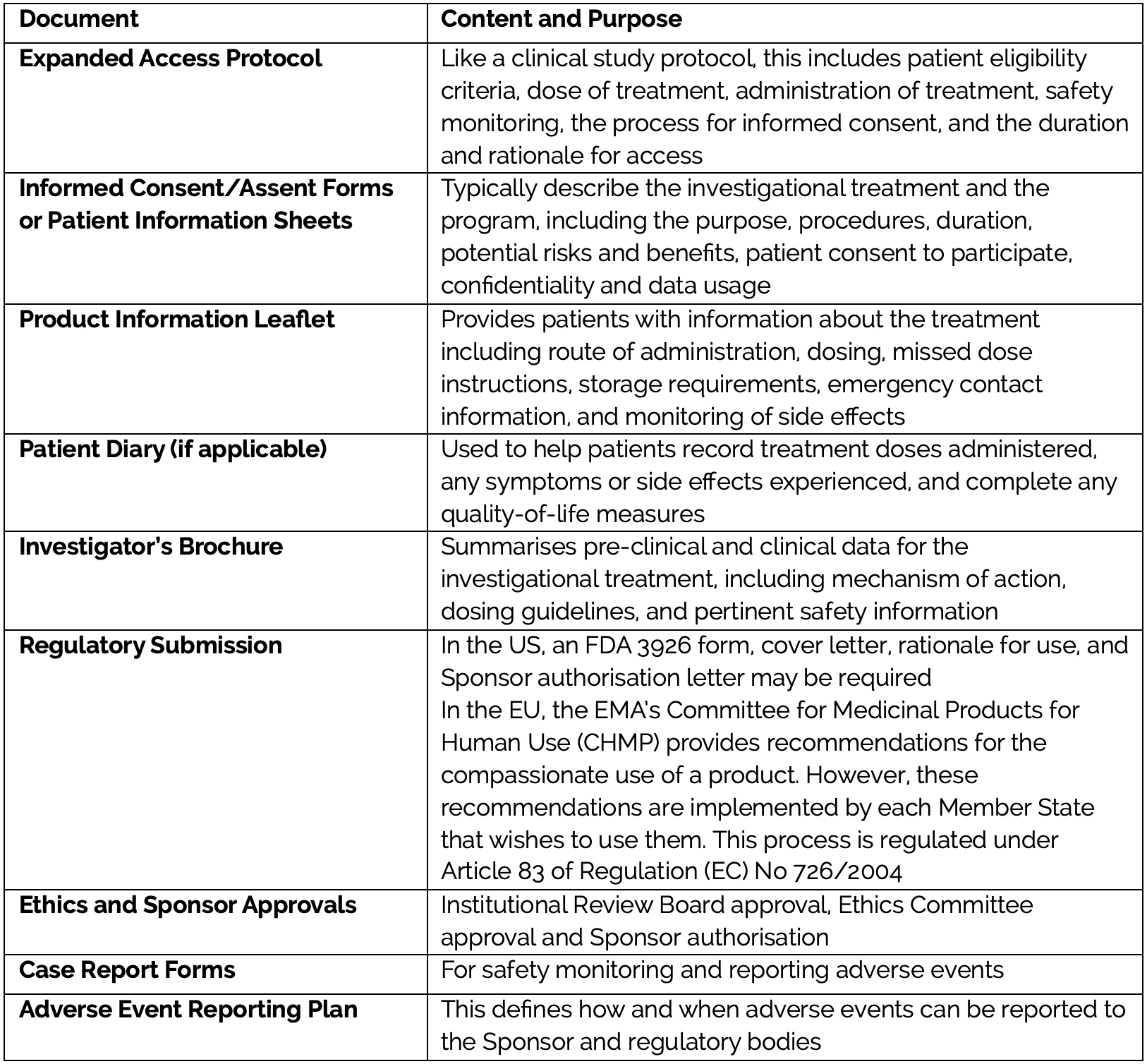
How are EAPs used within the regulatory framework?
EAPs help patients with serious or life-threatening conditions to access investigational treatments outside of a clinical trial ahead of drug approval.
Any real-world data collected (if performed) can lead to broader insights into drug efficacy and safety and can strengthen regulatory oversight of the investigational new treatment being studied.
What materials are needed to write EAP documents?
Pre‑clinical data, clinical data, and relevant publications are used to provide the rationale of the EAP.
Guidance from regulatory authorities (eg, FDA, EMA, MHRA, etc.) are used to ensure the EAP complies with country or region‑specific requirements. Some useful resources include the EMA’s Guideline on Compassionate Use of Medicinal Products, the MHRA’s Guidance for the Early Access to Medicines Scheme, and the FDA’s Guidance Document Expanded Access to Investigational Drugs for Treatment Use: Questions and Answers.
The EMA provides guidelines, but these are not legally binding, and member states retain significant autonomy in implementing EAPs. Each EU member state has its own national regulations governing EAPs, which can differ significantly from each other and from broader EU recommendations. Some countries have formal regulatory systems for EAPs; for example, in Belgium there is a Template of Compassionate Use Program protocol (Annex III), while other countries may have limited or no established processes.
Documents related to the investigational product are useful sources for EAP document development, including Investigator’s Brochure and any interim or final clinical study reports. Additionally, and template, style guidance, or product lexicons are also helpful to the medical writer.
What is the general timeline for writing EAPs?
Authoring timelines will vary, depending on the level of real-world data to be collected (if any) and the safety profile of the investigational treatment. However, EAP protocols tend to be less complex than clinical trial protocols, so typically take less time to develop including the usual 2 rounds of review and a quality control check ahead of finalisation.
Overview of the development of an EAP

Abbreviations: EAP = Expanded Access Program; QC = quality control; SME = subject matter expert.
Alchemy’s top tips and tricks for EAPs?
Based on our great work to date, we’ve been asked to generate numerous EAP protocols and their accompanying patient facing documents. We always ensure that we are provided with the most up to date lexicons, style guides, Investigator’s Brochures, and other salient materials needed for authoring the EAP documents. We work cross-functionally with real-world data (RWD) experts, project managers, and other consultants to glean information regarding any RWD collection, treatment administration, and therapy area. We maintain a consistent approach across documents, implementing client feedback, tracking progress to ensure timely delivery of all documents, and quality checking all client-approved documents before finalising.
How can I contact Alchemy about writing EAPs?
To discuss your EAP document needs, please contact our team: Contact
Sources:
Klopfenstein M, et al. Ther Innov Regul Sci. 2015;49(3):352–358.
European Medicines Agency. Guideline on Compassionate Use of Medicinal Products. Available at: https://www.ema.europa.eu/en/documents/regulatory-procedural-guideline/guideline-compassionate-use-medicinal-products-pursuant-article-83-regulation-ec-no-7262004_en.pdf. Accessed July 2025.
GOV.uk. Early Access to Medicines Scheme – Information for Applications. https://www.gov.uk/guidance/apply-for-the-early-access-to-medicines-scheme-eams. Accessed July 2025.
U.S. Food and Drug Administration. Expanded Access to Investigational Drugs for Treatment Use: Questions and Answers. https://www.fda.gov/regulatory-information/search-fda-guidance-documents/expanded-access-investigational-drugs-treatment-use-questions-and-answers-0#:~:text=This%20guidance%20provides%20information%20for%20industry%2C%20researchers%2C%20physicians%2C,which%20went%20into%20effect%20on%20October%2013%2C%202009. Accessed July 2025.
Federal Agency for Medicines and Health Products. Compassionate use – Medical need. Available at: https://www.famhp.be/en/human_use/medicines/medicines/research_development/compassionate_use_medical_need. Accessed July 2025.
