
What are literature reviews?
It a nutshell, a literature review is a comprehensive, critical analysis of existing academic work on a specific topic or research question. It does not merely list and describe sources, but rather, it critically examines the literature to uncover gaps, contradictions, and opportunities for further investigation.
What are the main requirements of a literature review?
Writing an impactful literature review requires a meticulous, multi-faceted approach. It begins with defining a clear, focused research question or objective to guide the review process.
Our team will work closely with you to develop this guiding research question, which will then inform the selection and synthesis of relevant literature. This also allows us to develop our PICOS criteria (population, intervention, comparator, outcomes, study design) which we will use to assess the eligibility of studies for inclusion in the review. We’ll draw upon a diverse array of resources including database searches, hand-searching of key journals, and citation tracking to uncover all potentially relevant literature.
Next, each source will be carefully evaluated for quality and relevance using the PICOS criteria. With a robust collection of sources in hand, our writers will synthesise the literature into a cohesive, insightful narrative. We’ll identify common themes, contradictions, and gaps across the body of research to inform meaningful conclusions and recommendations. Throughout this process, the review will be documented with detailed notetaking, source cataloguing, and version control.
The end result will be an authoritative, transparent summary of the current state of knowledge in your field of study.
How can literature reviews be used?
Literature reviews serve several key purposes:
1. Identifying gaps in the current knowledge base
Our reviews comprehensively examine the existing research, highlighting areas where more study is needed.
2. Collating a foundation of prior knowledge and research
We can synthesise previous work in any research field, providing a deep understanding of the current state of knowledge.
3. Understanding the implications of published research
Our analyses explain how existing studies can and should inform real-world practice, treatment, and decision-making
4. Contextualizing the potential impact of new research or drug products
Our literature reviews enable researchers, healthcare professionals, and policymakers to understand how current or future work may influence the field of study.
What additional document types or materials do you need to help you write a literature review?
To help write a comprehensive literature review, in addition to the relevant research sources, the key supporting document needed is a detailed protocol. This protocol is developed collaboratively with you at the start of the project and provides a roadmap for our writers during the review process.
The protocol establishes:
- The databases to be searched
- The specific search terms and framework to be used
- Any supplementary search strategies, such as manual checking of reference lists, conference materials, websites, guidelines and unpublished data sources
- The inclusion/exclusion criteria of the studies (PICOS criteria)
- The number of reviewers involved and the process for aligning data extraction
- The quality assessment tools to be utilised
- The format for presenting the synthesised data and the specific fields for data extraction
By outlining these key elements upfront, the protocol ensures the literature review is conducted in a rigorous, transparent, and comprehensive manner, aligned with your research objectives.
What is the general timeframe/timeline for writing a literature review?
The exact timeframe can vary depending on the breadth and complexity of your needs. While a rapid review may take 4 to 8 weeks to complete, a systematic review can take in the region of 3 to 6 months to complete thoroughly.
Overview of the literature review process
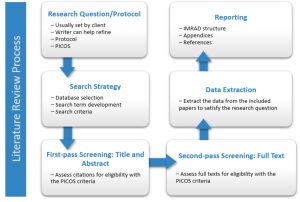
IMRAD = Introduction, Methods, Results, and Discussion; PICOS = population, intervention, comparator, outcomes, study design.
Alchemy’s top tips and tricks for writing multi-audience materials?
Defining a clear, focused research question or objective is absolutely critical. If the scope is too broad the literature can be unmanageable, but if the scope is too narrow, it can limit the usefulness of the data and generalisability of the findings. So, striking the right balance is crucial for an effective literature review.
